11. Coherence Length & Coherence Time
Module
Laser Light Concepts
Try it live
Explore this on the interactive simulator with real-time sliders and graphs: 🔬 Launch in Simulator
Aim
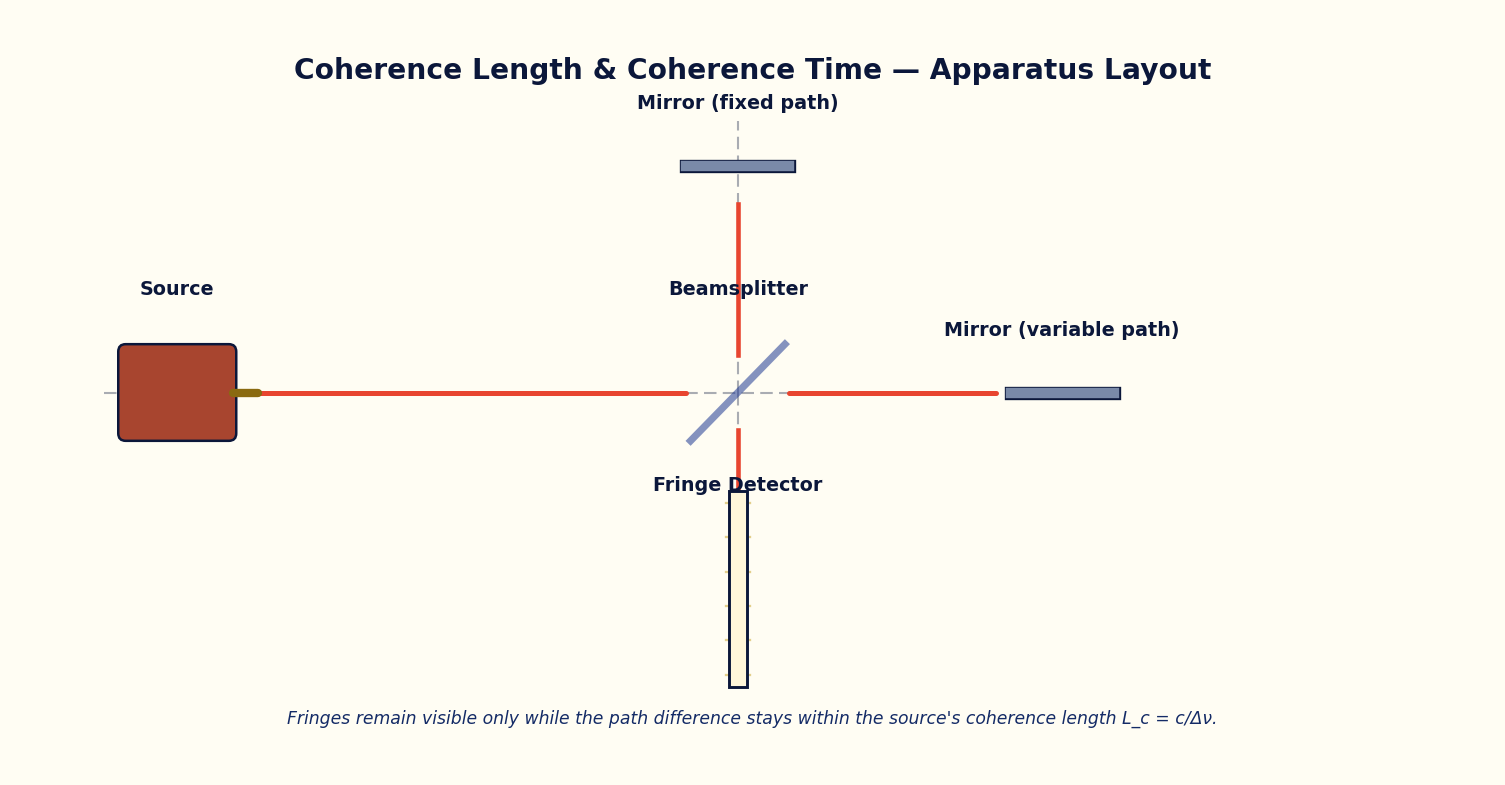
To study how the spectral linewidth of a source limits its coherence time and coherence length, and to observe the resulting loss of fringe visibility with increasing path difference.
Theoretical Background
An ideal monochromatic wave would maintain a perfectly definite phase relationship with itself indefinitely. Real sources, however, emit over a finite range of frequencies (linewidth Δν) because of finite emission-lifetime, Doppler, and other broadening mechanisms. This finite linewidth limits the time interval over which the wave's phase remains predictable — the coherence time, τc ≈ 1/Δν.
The corresponding coherence length, Lc = c·τc, is the maximum path difference between two beams derived from the same source for which a stable, high-contrast interference pattern can still be observed. Beyond this path difference, the fringes wash out because the relative phase between the two beams becomes effectively random from moment to moment.
A highly stabilized single-mode laser can have a coherence length of many metres, enabling holography and precision interferometry over large path differences, whereas an ordinary thermal source (LED or incandescent bulb) has a coherence length of only a few micrometres — far too short to show interference from two independently positioned sources of that type.
Governing Formulas
Coherence time:
Coherence length:
Simulator Controls
| Control | Symbol | Range | Unit |
|---|---|---|---|
| Source linewidth (via source type) | Δν | 1 MHz – hundreds of THz | Hz |
| Path difference under test | — | 0 – 500 | mm |
Procedure
- Select the stabilized single-mode laser source and record τc and Lc from the readouts.
- Increase the tested path difference from 0 upward and record the fringe visibility at each value, noting the path difference at which visibility drops to about half its maximum.
- Repeat the procedure for the He-Ne laser, the LED and the white-light source, tabulating τc, Lc, and the visibility-versus-path-difference behaviour for each.
- Plot Lc for the four source types on a logarithmic scale to appreciate the many-orders-of-magnitude spread.
Observation Table
Table: Coherence time and length for four representative sources
| S. No. | Source | Δν | τc (calculated) | Lc = cτc (calculated) | Path diff. at half-visibility (observed) |
|---|---|---|---|---|---|
| 1 | |||||
| 2 | |||||
| 3 | |||||
| 4 |
Graph
Plot Fringe visibility (y-axis) against Path difference (mm) (x-axis).
Expected trend: visibility ≈ 1 for path difference ≪ Lc, falling toward 0 as path difference approaches/exceeds Lc.
Fringe visibility vs path difference for each source, showing the coherence-length cut-off
Calculation
- For each source, compute τc = 1/Δν and Lc = c·τc from the given linewidth.
- Compare the calculated Lc with the path difference at which the simulator shows visibility dropping to ~50%, and comment on the agreement.
Result
Table: Coherence length: calculated vs observed
| Source | Lc (calculated) | Lc (from visibility curve) | Remarks |
|---|---|---|---|
| 1 | |||
| 2 | |||
| 3 |
Maximum Permissible Error
L_c = c/Δν (c is exact), so the fractional error in coherence length equals the fractional error in your measurement of the source's spectral linewidth.
Precautions
- Use a logarithmic scale when comparing coherence lengths across sources, since they differ by many orders of magnitude.
- Keep in mind that Lc is a practical cut-off (visibility falling below usefulness), not an abrupt mathematical boundary.
Self-Check Quiz
1. A source with a broader spectral linewidth Δν has:
- A) A longer coherence time
- B) A shorter coherence time (τc ≈ 1/Δν)
- C) The same coherence time regardless of linewidth
- D) No relationship between linewidth and coherence
Answer: B — τc ≈ 1/Δν is inversely proportional to linewidth — a spectrally pure (narrow-linewidth) source has a longer coherence time.
2. Beyond the coherence length Lc, what happens to the interference fringes?
- A) They become sharper
- B) They wash out / lose contrast, because the relative phase becomes effectively random
- C) They double in spacing
- D) Nothing changes
Answer: B — Past Lc, the two beams' relative phase is no longer predictable moment to moment, so a stable pattern can no longer be sustained.
3. A single-mode stabilized laser typically has a much longer coherence length than a white-light source because:
- A) Lasers are always more intense
- B) The laser has a far narrower spectral linewidth Δν
- C) White light travels slower
- D) Coherence length doesn't depend on linewidth
Answer: B — Since Lc = c/Δν, a laser's extremely narrow linewidth directly gives it an enormously longer coherence length than a broadband thermal source.
4. Which relation correctly connects coherence length and coherence time?
- A) Lc = c·τc
- B) Lc = τc/c
- C) Lc = c/τc
- D) Lc and τc are unrelated
Answer: A — Coherence length is simply the distance light travels during one coherence time: Lc = c·τc.
Viva-Voce Questions
- Why can two separate light bulbs never produce a stationary interference pattern, however carefully arranged?
- How is coherence length exploited (or limited) in holography and in optical coherence tomography?
- Why do white-light sources produce fringes only very close to zero path difference, unlike a laser?
- How is coherence time τc related to the spectral bandwidth Δν of a source?
- Distinguish between temporal coherence and spatial coherence.
- Why does an LED have a much shorter coherence length than a single-mode laser?
- How would you experimentally estimate the coherence length of a source using an interferometer such as Michelson's?