9. Compton Scattering
Module
Particle Nature of Light · Experiment 2
Try it live
Explore this on the interactive simulator with real-time sliders and graphs: 🔬 Launch in Simulator
Aim
To verify the Compton scattering formula by studying the wavelength shift of X-ray photons scattered by a free electron as a function of scattering angle.
Theoretical Background
When a high-energy photon (typically an X-ray) collides with a loosely bound (effectively free) electron, the interaction can be treated as an elastic, relativistic billiard-ball collision between two particles, provided the photon is assigned momentum p = h/λ in addition to its energy E = hν = hc/λ.
Applying conservation of relativistic energy and momentum to this two-body collision shows that the scattered photon must have a longer wavelength (lower energy) than the incident photon, with the wavelength shift Δλ depending only on the scattering angle θ and fundamental constants — not on the target material or the incident intensity.
This angle-only dependence, and the fact that the shift is of the exact size predicted only if the photon is treated as a particle with definite momentum, was decisive evidence (alongside the photoelectric effect) for the particle (quantum) nature of light, distinct from its well-established wave behaviour.
Governing Formulas
Compton shift:
Compton wavelength:
Scattered wavelength:
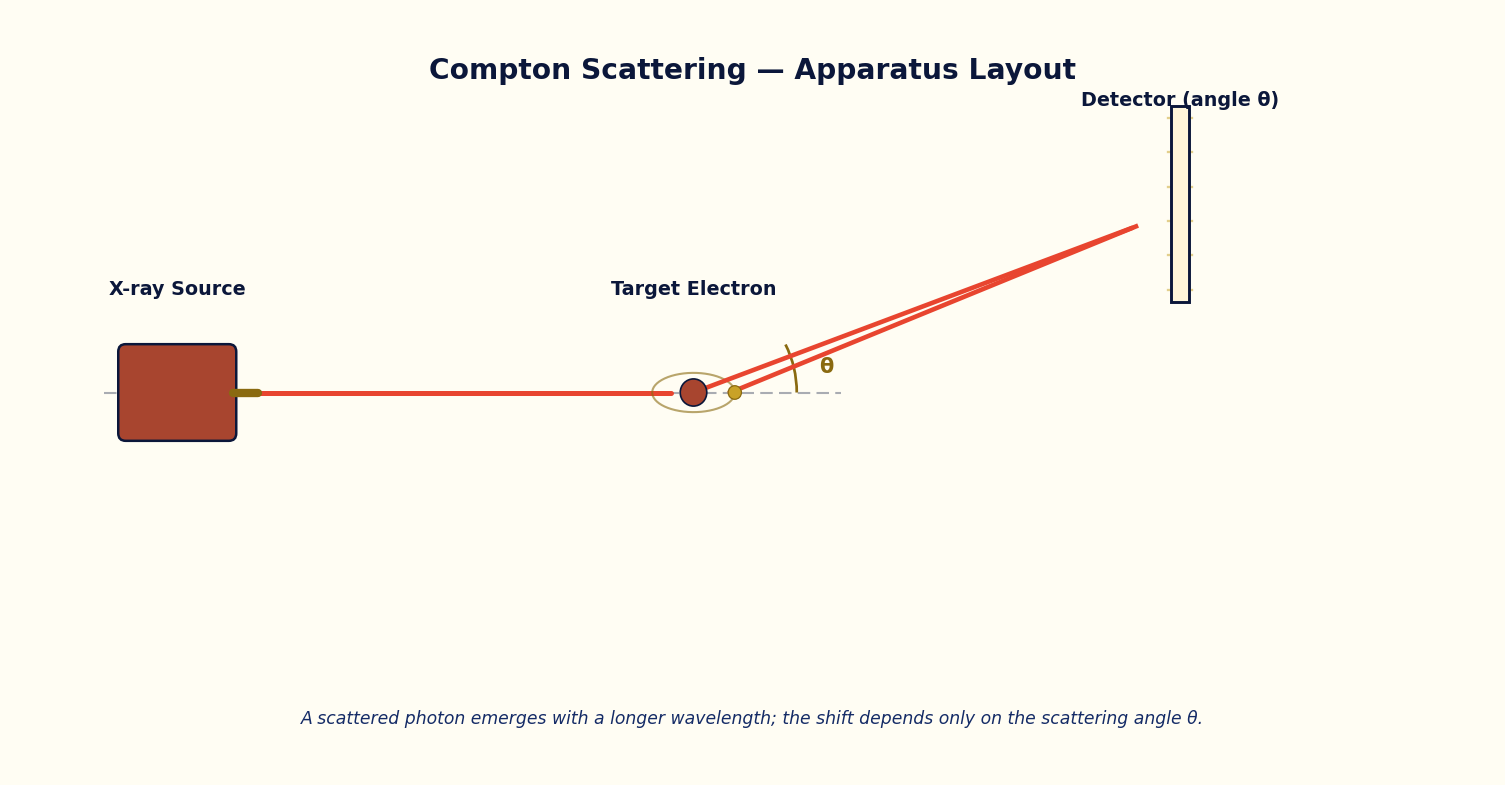
Simulator Controls
| Control | Symbol | Range | Unit |
|---|---|---|---|
| Incident X-ray wavelength | λ | 1 – 100 | pm |
| Scattering angle | θ | 0 – 180 | ° |
Procedure
- Fix the incident wavelength λ and vary the scattering angle θ from 0° to 180° in steps of 15°, recording the Compton shift Δλ and scattered wavelength λ' at each step.
- Repeat the run for a second incident wavelength and confirm that Δλ at a given angle is unchanged (i.e. independent of λ).
- Plot Δλ against (1 − cosθ) and verify a straight line through the origin of slope λC.
Observation Table
Table: Compton wavelength shift as a function of scattering angle (θ = 0° to 180°)
| S. No. | θ (°) | 1 − cosθ | λ (pm) | Δλ (pm) observed | λ' = λ+Δλ (pm) |
|---|---|---|---|---|---|
| 1 | |||||
| 2 | |||||
| 3 | |||||
| 4 | |||||
| 5 | |||||
| 6 | |||||
| 7 | |||||
| 8 | |||||
| 9 | |||||
| 10 | |||||
| 11 | |||||
| 12 | |||||
| 13 |
Graph
Plot Compton shift Δλ (pm) (y-axis) against (1 − cosθ) (x-axis).
Expected trend: a straight line through the origin of slope λC = 2.426 pm.
Δλ vs (1 − cosθ), used to extract the Compton wavelength
Calculation
- Plot Δλ against (1 − cosθ); the slope of the best-fit straight line gives the experimental Compton wavelength λC.
- Compare the experimental λC with the accepted value h/(mec) = 2.426 pm and compute the percentage error.
Result
Table: Determination of the Compton wavelength
| λC (accepted, pm) | λC (from slope, pm) | % error |
|---|---|---|
| 1 | ||
| 2 | ||
| 3 |
Maximum Permissible Error
Δλ = λ_C(1−cosθ); differentiating with respect to the scattering angle gives this term. The Compton wavelength λ_C is a fundamental constant with negligible uncertainty.
Precautions
- Note that Δλ depends only on θ and never on the incident wavelength or the scattering material — use this as a built-in consistency check.
- Take closely spaced readings near θ = 90° and θ = 180° where the shift changes most/reaches its maximum.
Self-Check Quiz
1. The Compton shift Δλ depends on:
- A) The scattering angle θ only (plus fundamental constants)
- B) The target material only
- C) The incident beam intensity only
- D) Both material and intensity, but not angle
Answer: A — Δλ = λ_C(1 − cosθ) depends only on the scattering angle and fundamental constants — famously independent of the target material, which was strong evidence for the photon picture.
2. At θ = 0° (no scattering), the Compton shift Δλ is:
- A) Maximum
- B) Zero
- C) Equal to λ_C
- D) Negative
Answer: B — Δλ = λ_C(1 − cos0°) = λ_C(1 − 1) = 0 — no deflection means no wavelength shift.
3. At what scattering angle is the Compton shift maximum?
- A) 0°
- B) 90°
- C) 180° (direct backscatter)
- D) 45°
Answer: C — Δλ = λ_C(1 − cosθ) is maximised when cosθ = −1, i.e. θ = 180°, giving Δλ = 2λ_C.
4. Compton's experiment required treating the photon as having, in addition to energy E = hν, a definite:
- A) Electric charge
- B) Rest mass
- C) Momentum, p = h/λ
- D) Magnetic moment
Answer: C — Assigning the photon momentum p = h/λ was essential to apply conservation of momentum in the photon–electron collision, alongside conservation of energy.
Viva-Voce Questions
- Why does Compton scattering require the photon to be assigned a definite momentum p = h/λ?
- Why is the Compton shift independent of the scattering material?
- Why is the Compton wavelength shift independent of the wavelength of the incident photon?
- Why is the Compton effect readily observed with X-rays but not with visible light?
- What does the Compton wavelength of the electron physically represent?
- Why does the scattered photon lose energy while the recoiling electron gains kinetic energy in this process?
- How does Compton scattering provide evidence for the particle (photon) nature of light?