14. Making a Hologram
Module
Laser Light Concepts
Try it live
Explore this on the interactive simulator with real-time sliders and graphs: 🔬 Launch in Simulator
Aim
To understand the recording and reconstruction stages of a hologram and to appreciate the role of coherent laser light in capturing both amplitude and phase information.
Theoretical Background
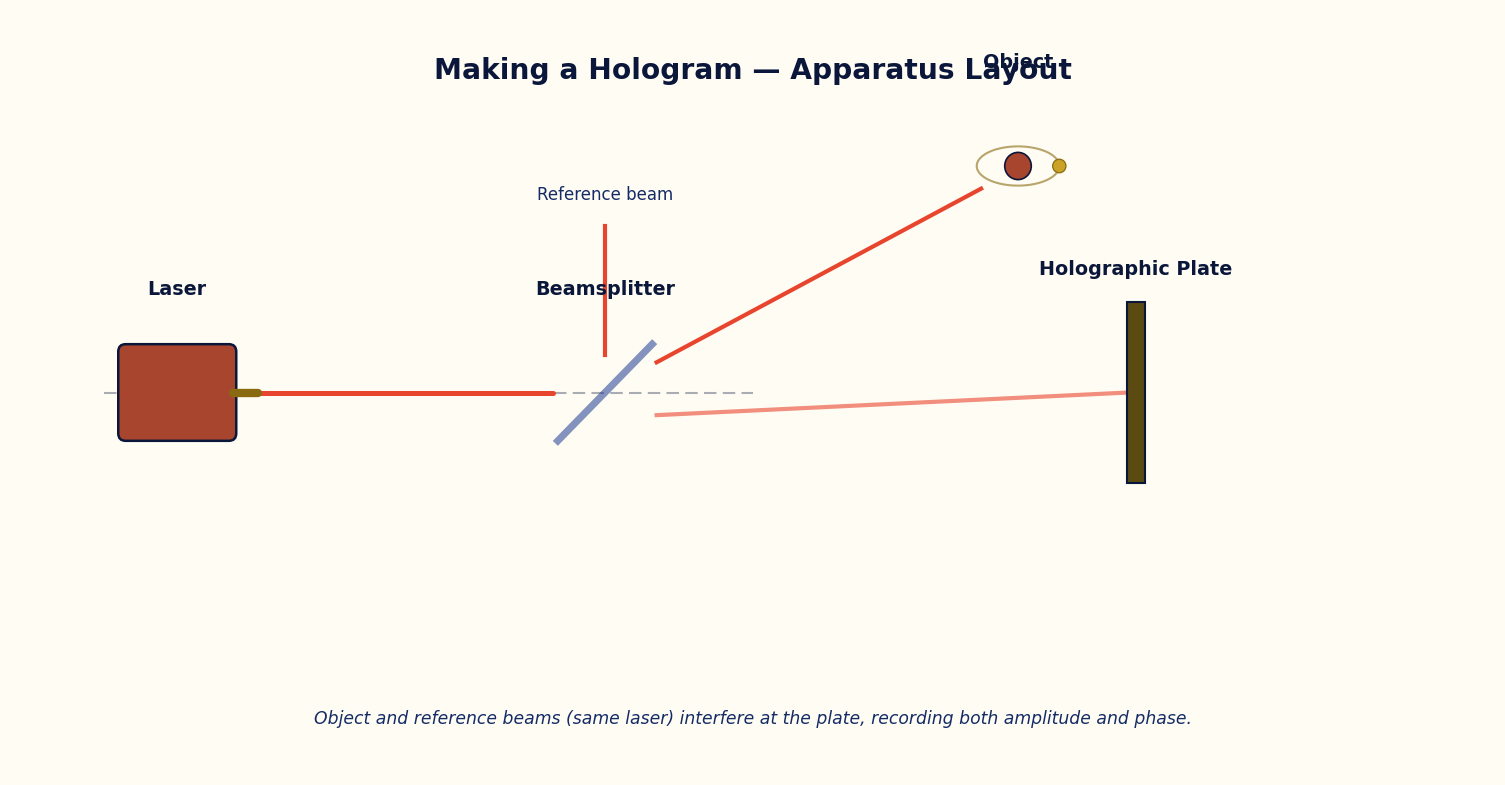
A conventional photograph records only the intensity (amplitude squared) of light reflected from a scene, discarding all information about the phase of the light waves — and hence all three-dimensional depth information. A hologram, in contrast, records the interference pattern formed between light scattered from the object (the object beam) and a mutually coherent reference beam derived from the same laser.
Because the two beams are coherent, their interference pattern — a microscopically fine fringe structure — encodes both the amplitude and the relative phase of the object wave at every point on the recording medium (a high-resolution photographic plate or equivalent). This recorded fringe pattern is the hologram.
To reconstruct the image, the developed hologram is illuminated with a beam identical to the original reference beam. The fine interference fringes act as a complex diffraction grating that reconstructs the original object wavefront, including its phase — producing a genuinely three-dimensional virtual image that appears to shift in perspective as the viewing angle changes, exactly as the original object would.
Governing Formulas
Recorded intensity at the plate:
Simulator Controls
| Control | Symbol | Range | Unit |
|---|---|---|---|
| Recording/reconstruction stage | — | 4 stages | — |
| Viewing angle (reconstruction only) | — | −30 – +30 | ° |
Procedure
- Step through stage 1 (object and reference beams meeting at the plate) and note how the two beams overlap.
- Step through stage 2 (interference pattern recorded on the plate) and note the fine fringe structure that encodes the object information.
- Step through stage 3 (illuminating the developed hologram with the reference beam alone) and observe how the fringe pattern begins to diffract the illuminating beam.
- Step through stage 4 (reconstructed wavefront) and vary the viewing angle to observe the parallax/perspective shift characteristic of a genuine 3-D image.
Observation Table
Table: The four stages of holographic recording and reconstruction
| Stage | Description observed | Key physical process at this stage |
|---|---|---|
| 1 | ||
| 2 | ||
| 3 | ||
| 4 |
Graph
Plot Apparent perspective shift of reconstructed image (y-axis) against Viewing angle (°) (x-axis).
Expected trend: a smooth, continuous shift in apparent viewpoint as angle changes, confirming genuine 3-D reconstruction.
Qualitative record of perspective change with viewing angle during reconstruction
Calculation
- Identify, from the recorded intensity expression, which cross term (2·Re(E_obj E_ref*)) is responsible for carrying the phase information of the object beam.
- Note qualitatively how the fringe spacing on the plate depends on the angle between the object and reference beams (finer fringes for larger angles).
Result
Table: Summary of the holographic recording/reconstruction sequence
| Stage | Physical process |
|---|---|
| 1 | |
| 2 | |
| 3 |
Maximum Permissible Error
Holography as presented here is a qualitative recording/reconstruction demonstration, not an instrumental measurement — there is no single numeric result with a propagated maximum permissible error. Use the space below to sketch/note the four stages instead.
Precautions
- Distinguish clearly between the recording stages (1–2, needs both beams) and the reconstruction stages (3–4, needs only the reference beam and the developed plate).
- Note that only coherent, monochromatic light (a laser) can produce a usable hologram — this links directly to the Coherence and Monochromaticity experiments.
Self-Check Quiz
1. Unlike an ordinary photograph, a hologram records:
- A) Only the intensity of the object beam
- B) Both the amplitude and the relative phase of the object wave
- C) Only colour information
- D) Nothing about the object beam at all
Answer: B — The interference between object and reference beams encodes phase as well as amplitude, which is what allows full 3-D reconstruction.
2. Why must the object beam and reference beam come from the same laser?
- A) To save power
- B) So they are mutually coherent and can form a stable interference pattern
- C) It doesn't matter, any two lasers work
- D) To make the object appear brighter
Answer: B — Only mutually coherent beams (same source, fixed phase relationship) produce a stable fringe pattern that can be recorded as a hologram.
3. The recorded intensity at the photographic plate is given by I = |E_obj + E_ref|². The cross term 2Re(E_obj·E_ref*) is important because it:
- A) Is always zero and can be ignored
- B) Is the term that actually encodes the phase information of the object wave
- C) Only affects the colour of the hologram
- D) Represents pure noise
Answer: B — The cross term is where the interference — and therefore the phase information about the object — actually lives; the other two terms are just the individual beam intensities.
4. What fundamentally makes holography possible that an ordinary camera lacks?
- A) A bigger lens
- B) A highly coherent light source (laser) needed to form a stable interference pattern
- C) A faster shutter speed
- D) A colour film
Answer: B — Ordinary cameras use incoherent light and record intensity only; holography specifically requires a coherent source to capture and later reconstruct phase via interference.
Viva-Voce Questions
- Why must the reference and object beams originate from the same laser source?
- What distinguishes a hologram from an ordinary photograph in terms of the information each one records?
- Why must both the object beam and the reference beam originate from the same laser source?
- What information is recorded on a holographic plate that is not recorded on an ordinary photograph?
- Why must a holographic plate record both amplitude and phase information for a full 3-D reconstruction?
- What happens if the reconstruction beam does not match the original reference beam in wavelength or direction?
- Explain the difference between the real and virtual images formed during hologram reconstruction.