12. Directionality & Beam Quality
Module
Laser Light Concepts
Try it live
Explore this on the interactive simulator with real-time sliders and graphs: 🔬 Launch in Simulator
Aim
To compare the angular divergence of a laser beam with that of a conventional light source and to determine the spot size produced at a given propagation distance.
Theoretical Background
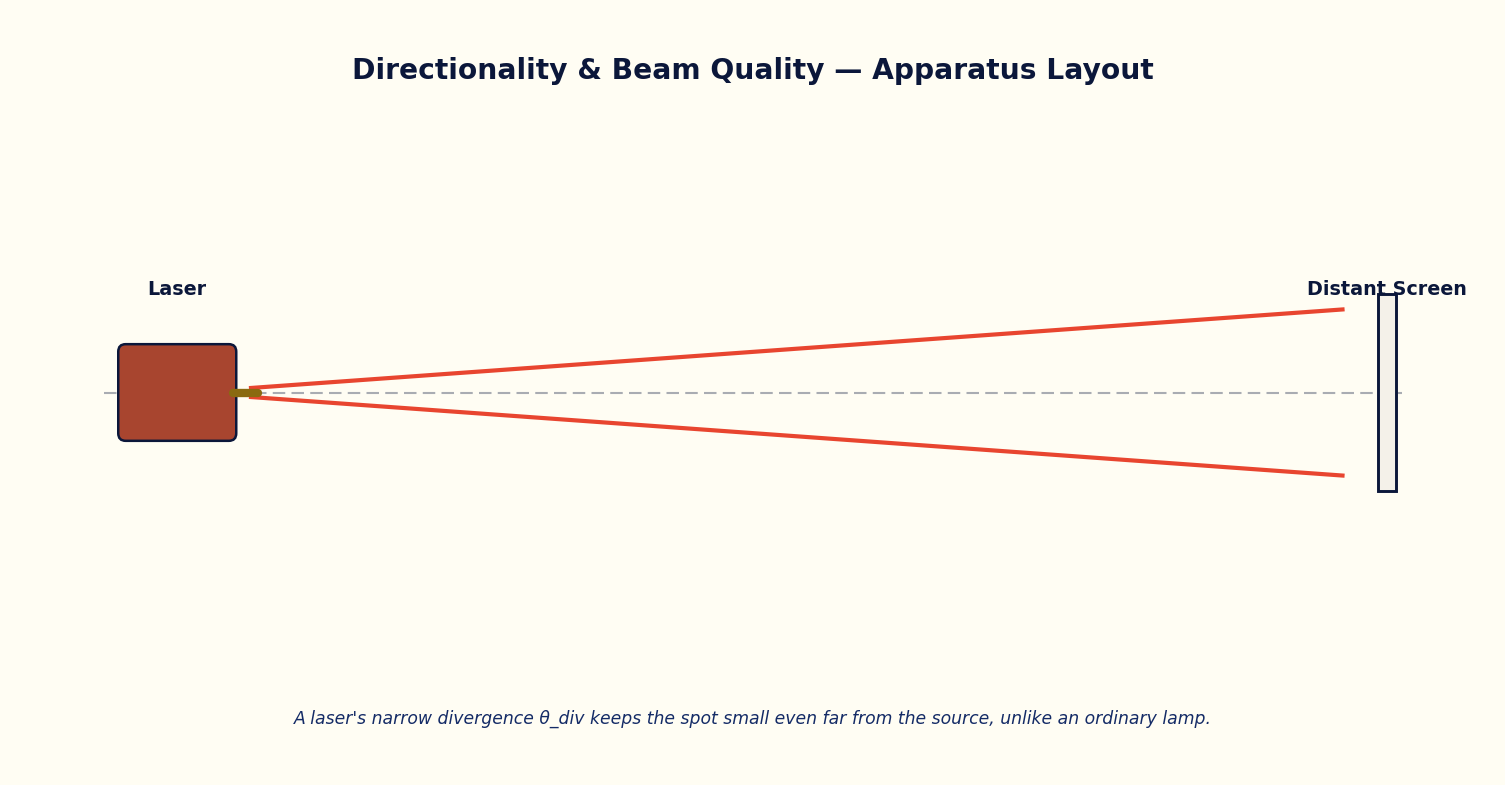
An ordinary lamp radiates light in essentially all directions (a solid angle of order 4π steradians), so its intensity falls off rapidly with distance and no useful 'beam' can be projected over long ranges without extensive collimating optics. A laser's optical cavity, by contrast, selectively amplifies light travelling very close to the cavity axis, producing an output beam of very small angular divergence.
For a beam of full-angle divergence θ_div (in radians, typically expressed in milliradians for lasers), the diameter of the illuminated spot at a propagation distance L is approximately D_spot ≈ D0 + θ_div · L, where D0 is the initial beam diameter — for large L the second term dominates.
This low divergence (directionality) is what allows a laser to remain useful for surveying, alignment, ranging (as in the LIDAR workshop) and long-distance power delivery, and is intimately connected to the same spatial and temporal coherence properties studied in the coherence experiment.
Governing Formulas
Spot diameter at distance L:
Simulator Controls
| Control | Symbol | Range | Unit |
|---|---|---|---|
| Beam divergence angle | θ_div | 0.1 – 500 | mrad |
| Propagation distance | L | 1 – 1000 | m |
Procedure
- Set the divergence to a typical He-Ne laser value (~1 mrad) and record the spot diameter at several propagation distances from 1 m to 1000 m.
- Repeat for a much larger divergence (representative of an unfocused lamp, hundreds of mrad) and tabulate the spot diameter at the same distances.
- Plot spot diameter against propagation distance for both cases on the same axes and compare the slopes.
Observation Table
Table: Spot diameter versus propagation distance for laser-like and lamp-like divergence
| S. No. | θ_div (mrad) | L (m) | Spot diameter (observed) |
|---|---|---|---|
| 1 | |||
| 2 | |||
| 3 | |||
| 4 | |||
| 5 | |||
| 6 | |||
| 7 | |||
| 8 |
Graph
Plot Spot diameter (y-axis) against Propagation distance L (m) (x-axis).
Expected trend: a straight line whose slope equals θ_div.
Spot diameter vs distance for two divergence settings, illustrating directionality
Calculation
- From the slope of each spot-diameter vs distance line, extract the experimental θ_div and compare with the value set on the simulator.
- Estimate the distance at which a lamp-like source's spot would exceed 1 m in diameter and compare with the corresponding distance for a laser.
Result
Table: Verification of beam-divergence measurement
| θ_div set (mrad) | θ_div from slope (mrad) | % deviation |
|---|---|---|
| 1 | ||
| 2 | ||
| 3 |
Maximum Permissible Error
D_spot(L) = D₀ + θ_div·L is a sum, so absolute (not fractional) errors add directly, each weighted by the relevant partial derivative.
Precautions
- Use a wide enough range of propagation distances to clearly distinguish the slopes of the two cases.
- Remember that real laser beams have a minimum waist size even at the source; the linear approximation holds well away from the waist.
Self-Check Quiz
1. An ordinary lamp radiates into roughly what solid angle, compared to a laser?
- A) The same solid angle as a laser
- B) A much larger solid angle (order 4π steradians) versus a laser's narrow, highly directional beam
- C) Zero solid angle
- D) A smaller solid angle than a laser
Answer: B — A lamp emits in essentially all directions, while a laser cavity selectively amplifies light near the cavity axis, producing a narrow beam.
2. At large propagation distance L, the spot diameter D_spot(L) ≈ D0 + θ_div·L is dominated by:
- A) The initial beam diameter D0
- B) The divergence term θ_div·L
- C) Neither term matters at large L
- D) The laser's wavelength alone
Answer: B — For large L, θ_div·L grows without bound while D0 stays fixed, so divergence dominates the spot size at long range.
3. A laser with smaller angular divergence θ_div will, at a fixed distance L, produce:
- A) A larger spot
- B) A smaller, more tightly confined spot
- C) No spot at all
- D) The same spot size regardless of θ_div
Answer: B — Smaller divergence means the beam spreads less per unit distance, so the illuminated spot at any given range is smaller.
4. Why can't an ordinary lamp be used to illuminate a distant target the way a laser can, without extra optics?
- A) Lamps are always dimmer than lasers in total power
- B) Its light spreads over a huge solid angle, so intensity falls off rapidly with distance
- C) Lamps only emit infrared light
- D) Lamps cannot be turned on and off quickly
Answer: B — Without the laser cavity's directional amplification, a lamp's power is spread over a huge solid angle, diluting intensity at range.
Viva-Voce Questions
- Why is directionality considered one of the defining properties of laser light, alongside coherence and monochromaticity?
- How does beam divergence limit the maximum useful range of a laser rangefinder or LIDAR system?
- Why does an ordinary lamp's light spread out so much more than a laser beam over the same distance?
- What is meant by beam divergence, and in what units is it typically expressed?
- How does the M² (beam quality) factor describe how close a real laser beam is to an ideal Gaussian beam?
- Why is low divergence important for applications such as laser range-finding or optical communication?
- How would you measure the divergence angle of a laser beam experimentally?