15. Red → Ultraviolet Wavelength & Photon-Energy Explorer
Module
Explore & Stay Safe
Try it live
Explore this on the interactive simulator with real-time sliders and graphs: 🔬 Launch in Simulator
Aim
To explore, across the visible spectrum and into the ultraviolet, how wavelength, frequency, photon energy and ocular/skin hazard all change together as a single continuous slider is swept from deep red toward UV-C.
Theoretical Background
Visible light occupies only a narrow band (roughly 380–700 nm) of the full electromagnetic spectrum, flanked by the near-infrared on the long-wavelength side and the ultraviolet on the short-wavelength side. Within this explorer, wavelength λ is the independent variable; frequency ν and photon energy E are both derived from it.
Because frequency and photon energy are inversely proportional to wavelength, shorter-wavelength light is simultaneously higher in frequency and carries more energetic photons. This has two separate, easily confused consequences that the explorer is designed to make concrete:
- Colour changes because the human eye's photopic response depends on wavelength — but only across the visible window (380–700 nm). Outside this window (UV or IR), the light is invisible even though it still carries energy.
- Hazard increases with photon energy for two distinct reasons: (i) higher-energy visible/near-UV photons contribute more to photochemical retinal stress in addition to ordinary thermal retinal burns, and (ii) once photon energy is high enough (UV-A and beyond), the light becomes invisible, so the eye's natural blink/aversion reflex — which depends on seeing the light — no longer offers any protection at all.
This is why an invisible UV or deep-red/near-IR laser beam of the same power as a visible one is often more dangerous in practice, not less: the eye gives no warning before exposure occurs.
Governing Formulas
Frequency from wavelength:
Photon energy (in electron-volts, using h in eV·s):
where c = 3×10⁸ m/s and h = 4.1357×10⁻¹⁵ eV·s.
Simulator Controls
| Control | Symbol | Range | Unit |
|---|---|---|---|
| Wavelength | λ | 200 – 750 | nm |
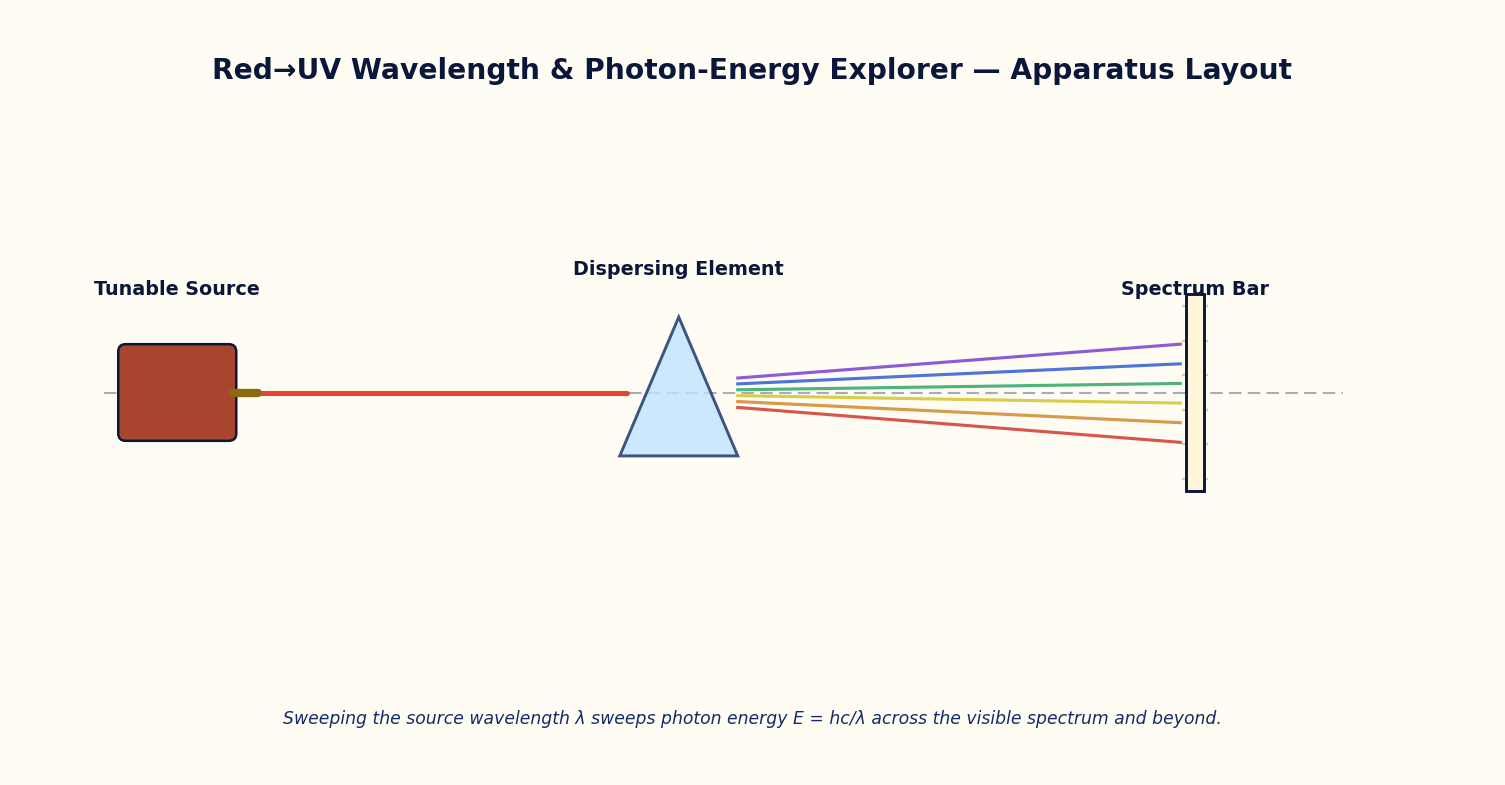
The simulator continuously reports the corresponding spectral region (deep red/NIR boundary → red → orange → yellow → green → blue → violet → UV-A → UV-B → UV-C), frequency ν, photon energy E, and a hazard note specific to that region.
Procedure
- Start at λ = 700 nm (deep red) and record the displayed region, frequency, photon energy and hazard note.
- Sweep the slider in steps of roughly 50 nm down through the visible spectrum (orange → yellow → green → blue → violet), recording the same four quantities at each step.
- Continue the sweep into the ultraviolet (UV-A, UV-B, UV-C) down to λ = 200 nm, noting in particular where the light becomes invisible and how the hazard description changes at that point.
- Identify, from your table, the wavelength at which (a) the colour name changes from visible to "invisible/UV", and (b) the hazard note first mentions loss of the blink reflex.
Observation Table
Table: Region, frequency, photon energy and hazard vs wavelength
| S. No. | Wavelength λ (nm) | Region | Frequency ν (THz) | Photon energy E (eV) | Hazard note (summary) |
|---|---|---|---|---|---|
| 1 | |||||
| 2 | |||||
| 3 | |||||
| 4 | |||||
| 5 | |||||
| 6 | |||||
| 7 | |||||
| 8 |
Graph
Plot Photon energy E (eV) (y-axis) against Wavelength λ (nm) (x-axis), for all recorded points.
Expected trend: a smooth, monotonically decreasing curve (E ∝ 1/λ) — not a straight line.
Photon energy falls as wavelength increases, following an inverse relationship
Calculation
- Using E = hc/λ, calculate the photon energy at λ = 700 nm (red), λ = 550 nm (green) and λ = 250 nm (UV-C), and compare with the simulator's displayed values.
- Calculate the ratio of photon energy at λ = 250 nm to that at λ = 700 nm, and comment on why UV-C photons are so much more biologically damaging per photon than red photons.
Result
Table: Calculated vs simulator-displayed photon energy at representative wavelengths
| λ (nm) | E calculated (eV) | E displayed by simulator (eV) | Region |
|---|---|---|---|
| 700 | |||
| 550 | |||
| 250 |
Maximum Permissible Error
E = hc/λ (h, c exact), so the fractional error in photon energy equals the fractional error in the wavelength measurement/setting.
Precautions
- Remember that this explorer illustrates energy and hazard trends, not a specific laser's actual measured power or beam profile.
- Do not confuse frequency (which increases toward UV) with wavelength (which decreases toward UV) when filling in the observation table.
- Pay particular attention to the wavelengths at which the hazard note mentions the loss of the natural blink reflex — this is the single most important safety concept this explorer conveys.
Self-Check Quiz
1. As wavelength decreases from red toward UV, photon energy:
- A) Decreases
- B) Increases (E = hc/λ, inversely proportional to λ)
- C) Stays constant
- D) Becomes zero
Answer: B — E = hc/λ means shorter wavelengths always carry more energetic photons, which is why UV is more biologically damaging per photon than red light.
2. Why is an invisible UV or deep-IR laser beam often more dangerous than a visible beam of the same power?
- A) Invisible light always has more power
- B) The eye's natural blink/aversion reflex depends on seeing the light, so it offers no protection against invisible wavelengths
- C) UV and IR light cannot damage the eye
- D) Invisible beams travel faster
Answer: B — The blink reflex is a visual response — it simply doesn't trigger for light the eye cannot see, removing a layer of natural protection.
3. UV-B is described as being absorbed mostly by which part of the eye/body, rather than reaching the retina?
- A) The retina directly, just like visible light
- B) The cornea and skin surface
- C) It passes through the body without being absorbed at all
- D) The optic nerve
Answer: B — UV-B is strongly absorbed at the cornea/skin surface (causing effects like photokeratitis and sunburn) rather than penetrating to the retina.
4. Which quantity is the independent variable that the explorer's slider directly controls?
- A) Photon energy
- B) Frequency
- C) Wavelength λ
- D) Hazard class
Answer: C — The slider sets λ directly; frequency ν = c/λ and photon energy E = hc/λ are both derived quantities computed from it.
Viva-Voce Questions
- Why does photon energy increase as wavelength decreases, even though the speed of light c is constant?
- Why is an invisible ultraviolet or infrared beam potentially more hazardous than a visible beam of the same power?
- At what approximate wavelength does human vision stop, and what governs this limit?
- Give one real laser type each that would fall in the UV-A, UV-B and UV-C regions covered by this explorer.
- Why is the relationship between photon energy and frequency linear, while the relationship between energy and wavelength is not?
- Why are X-rays and gamma rays, despite their very short wavelengths, considered more hazardous to biological tissue than visible light?
- What determines whether a given photon can ionize an atom it interacts with?