6. Focusing of Light by a Convex Lens
Module
Geometrical Optics · Module 5
Try it live
Explore this on the interactive simulator with real-time sliders and graphs: 🔬 Launch in Simulator
Aim
To study ray-optics focusing by a convex lens and to determine the diffraction-limited minimum spot size set by the lens aperture.
Theoretical Background
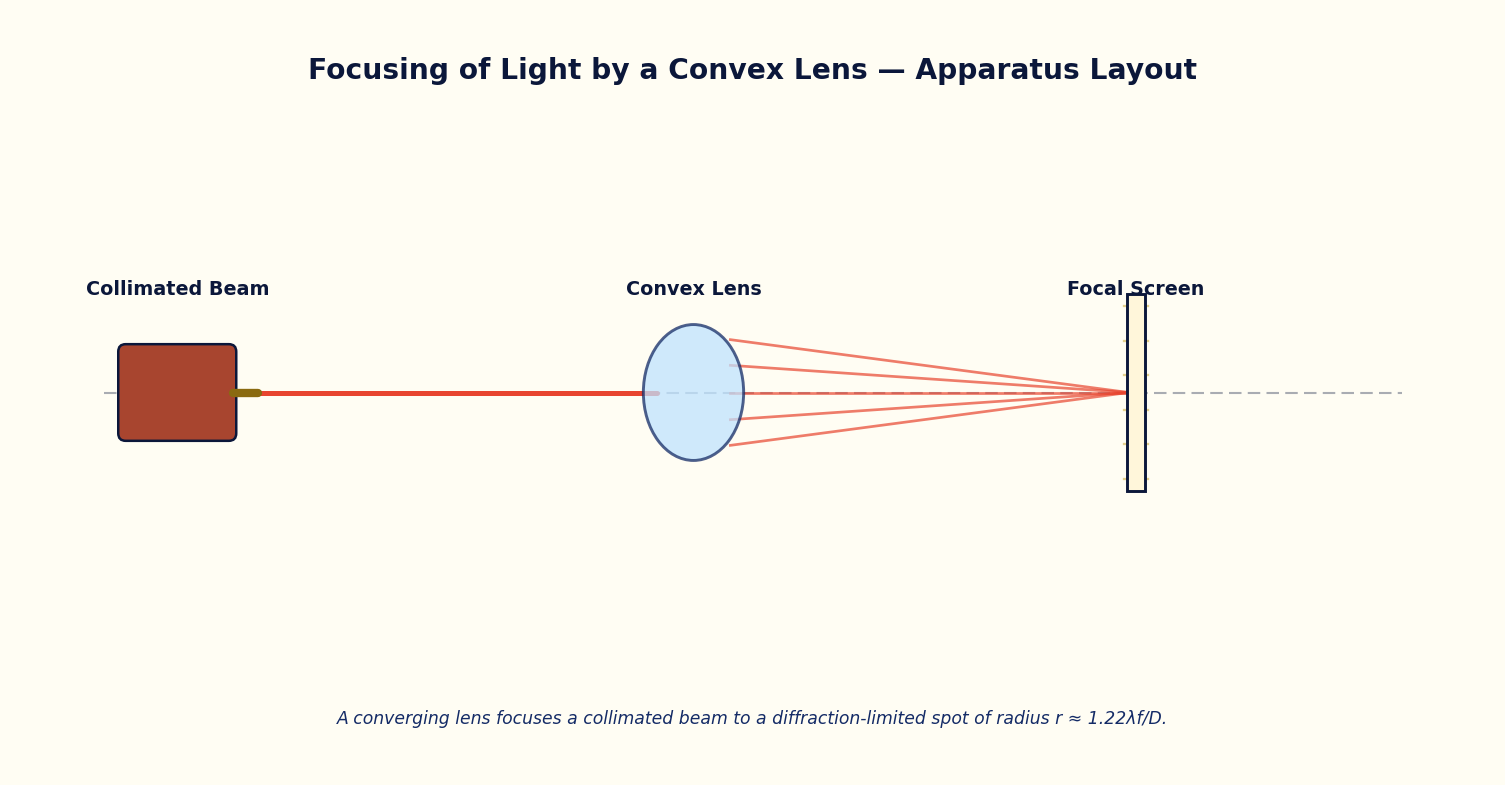
In the idealised ray (geometrical) picture, a convex lens brings parallel rays to a single point at its focal length f. In practice, however, no lens can focus light to a true mathematical point: the finite aperture D of the lens diffracts the beam, producing an Airy pattern whose central spot has a finite radius.
The ratio f/D, called the f-number, characterises how tightly a lens can focus light — a smaller f-number (relatively larger aperture) produces a smaller, more intense focal spot, right up to the diffraction limit. The radius of the Airy disc (first dark ring of the diffraction pattern) is given by 1.22 λ f/D, so shorter wavelengths and smaller f-numbers both produce tighter foci.
This diffraction limit sets the ultimate resolution of any imaging or focusing optical system, from microscope objectives to laser-machining heads, and is directly relevant to the industrial laser-processing workshops (drilling, cutting, welding) elsewhere in this lab, where a small focused spot is essential for high power density.
Governing Formulas
f-number:
Diffraction-limited (Airy) spot radius:
Simulator Controls
| Control | Symbol | Range | Unit |
|---|---|---|---|
| Focal length | f | 5 – 30 | cm |
| Aperture (lens diameter) | D | 1 – 10 | cm |
| Wavelength | λ | 400 – 700 | nm |
Procedure
- Set λ to a fixed value and vary the focal length f at constant aperture D; record the f-number and the Airy spot radius at each setting.
- Reset f and vary the aperture D over its full range; record the f-number and spot radius.
- Repeat for a second wavelength and compare the spot radii obtained.
- Plot spot radius against f-number and verify the expected linear relationship.
Observation Table
Table: Diffraction-limited spot radius as a function of f-number
| S. No. | f (cm) | D (cm) | f-number = f/D | λ (nm) | Spot radius 1.22λf/D (μm) |
|---|---|---|---|---|---|
| 1 | |||||
| 2 | |||||
| 3 | |||||
| 4 | |||||
| 5 | |||||
| 6 | |||||
| 7 | |||||
| 8 |
Graph
Plot Airy spot radius (μm) (y-axis) against f-number (f/D) (x-axis).
Expected trend: a straight line through the origin of slope 1.22λ.
Spot radius vs f-number at fixed wavelength
Calculation
- For each trial compute the f-number and the theoretical Airy radius, and compare with the simulator readout.
- From the slope of the spot-radius vs f-number graph, extract an experimental wavelength (slope = 1.22λ) and compare with the set value.
Result
Table: Wavelength check from diffraction-limited focusing
| λ set (nm) | λ from slope (nm) | % deviation |
|---|---|---|
| 1 | ||
| 2 | ||
| 3 |
Maximum Permissible Error
r = 1.22λf/D is a product/quotient of three measured quantities — sum the fractional (least count / value) errors of each.
Precautions
- Remember that a smaller f-number always gives a tighter spot, but only up to the diffraction limit — geometry alone never predicts a zero-size point.
- Keep wavelength fixed while studying the f versus D dependence, and vice versa.
Self-Check Quiz
1. A lens with f = 100 mm and D = 50 mm has an f-number of:
- A) 0.5
- B) 1
- C) 2
- D) 5000
Answer: C — N_f = f/D = 100/50 = 2 (often written f/2).
2. Reducing the f-number (relatively larger aperture, same f) has what effect on the diffraction-limited spot size?
- A) Makes it larger
- B) Makes it smaller (tighter focus)
- C) No effect
- D) Makes the spot disappear
Answer: B — r_Airy ∝ f/D = N_f, so a smaller f-number gives a smaller Airy spot radius, i.e. a tighter focus.
3. Why can't any real lens focus light to a true mathematical point, even with a perfect, aberration-free design?
- A) All glass absorbs some light
- B) The finite aperture diffracts the beam, producing an Airy pattern of finite size
- C) Lenses always have chromatic aberration
- D) Only laser light can be focused to a point
Answer: B — Diffraction from the finite aperture D is a fundamental physical limit (not a manufacturing defect), setting the Airy-disk floor on spot size.
4. Comparing two wavelengths at the same f-number, which one focuses to the smaller spot?
- A) The longer wavelength
- B) The shorter wavelength
- C) Both are identical
- D) Wavelength has no effect on spot size
Answer: B — r_Airy ≈ 1.22 λf/D is directly proportional to λ, so shorter wavelengths focus to smaller diffraction-limited spots.
Viva-Voce Questions
- Why can a lens never focus light to a true geometric point, however well it is corrected for aberrations?
- How does the diffraction-limited spot size influence the achievable precision in a laser-drilling or laser-cutting process?
- Why can a lens never focus a perfectly collimated beam to a true mathematical point, however good its quality?
- How does the diffraction-limited spot size change if the lens aperture D is increased?
- What is meant by the f-number (f/D) of a lens system, and how does it affect the focal spot size?
- Why does a shorter wavelength give a smaller diffraction-limited spot for the same lens and aperture?
- Distinguish between a diffraction-limited and an aberration-limited focal spot.