13. Monochromaticity & Spectral Purity
Module
Laser Light Concepts
Try it live
Explore this on the interactive simulator with real-time sliders and graphs: 🔬 Launch in Simulator
Aim
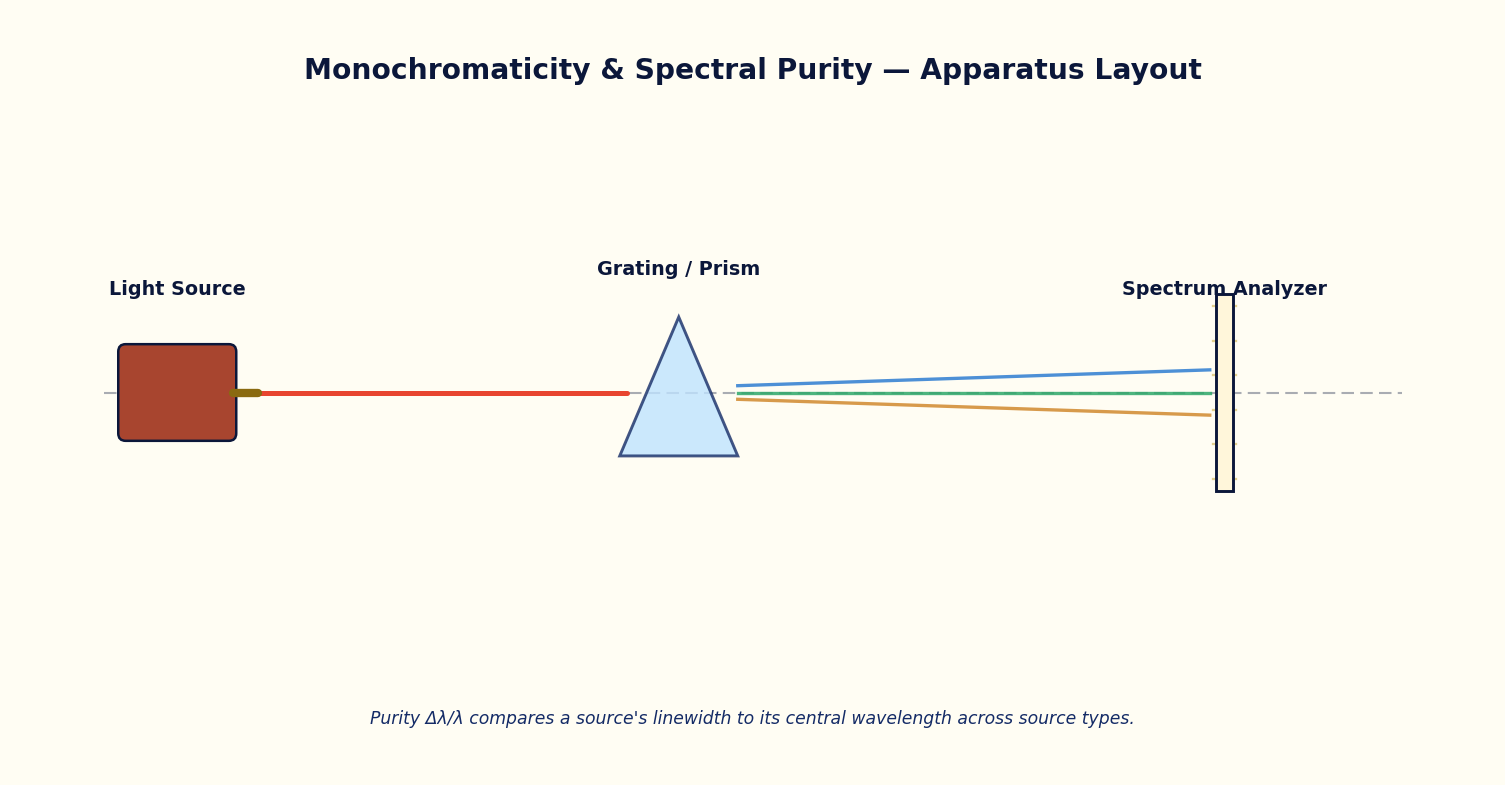
To compare the spectral purity of different light sources by measuring the ratio Δλ/λ of linewidth to central wavelength.
Theoretical Background
Monochromaticity describes how closely a source approaches emitting a single, pure wavelength. In practice, every real source emits over some finite spectral width Δλ centred on a nominal wavelength λ; the quantity Δλ/λ is called the spectral purity (a smaller value indicates a purer, more nearly monochromatic source).
A single-mode stabilized laser can achieve Δλ/λ of order 10⁻⁶ or better, a multimode gas laser typically 10⁻⁴, a light-emitting diode around 3×10⁻², and a white-light (thermal) source close to unity, since it emits across essentially the whole visible band.
High spectral purity is essential wherever precise wavelength-dependent effects matter: spectroscopic resolution, coherence length (and hence holography), and wavelength-division multiplexing in fibre-optic communications, where adjacent channels must not spectrally overlap.
Governing Formulas
Spectral purity:
Simulator Controls
| Control | Symbol | Range | Unit |
|---|---|---|---|
| Central wavelength | λ | 400 – 700 | nm |
| Source type (linewidth Δλ) | Δλ | 0.001 – 250 | nm |
Procedure
- For each of the four source types (single-mode laser, multimode gas laser, LED, white-light source), set the central wavelength to a common value and record Δλ and the computed purity Δλ/λ.
- Repeat for at least two different central wavelengths and confirm that the purity ratio for a given source type scales as expected.
- Tabulate and rank the four sources by spectral purity.
Observation Table
Table: Spectral purity of representative source types at a fixed central wavelength
| S. No. | Source type | λ (nm) | Δλ (nm) | Purity Δλ/λ |
|---|---|---|---|---|
| 1 | ||||
| 2 | ||||
| 3 | ||||
| 4 |
Graph
Plot Spectral purity Δλ/λ (log scale) (y-axis) against Source type (ranked) (x-axis).
Expected trend: values spanning several orders of magnitude, laser < LED < white light.
Comparative bar/log chart of spectral purity across source types
Calculation
- Compute Δλ/λ for every tabulated row and rank the sources from most to least monochromatic.
- Relate the purity value of the multimode gas laser to the coherence length computed in the Coherence experiment, and check the two results for consistency (smaller Δλ/λ ⇔ longer Lc, at fixed λ).
Result
Table: Spectral purity ranking of the four sources
| Source | Δλ/λ | Relative ranking |
|---|---|---|
| 1 | ||
| 2 | ||
| 3 |
Maximum Permissible Error
purity = W/λ, where W is the measured spectral linewidth. Sum the fractional error in the linewidth measurement and in the central-wavelength measurement.
Precautions
- Use a logarithmic scale when comparing purity values, since they differ by orders of magnitude across source types.
- Keep the central wavelength fixed while comparing source types so that the comparison isolates Δλ alone.
Self-Check Quiz
1. A smaller spectral purity value Δλ/λ indicates:
- A) A less pure, broader-spectrum source
- B) A purer, more nearly monochromatic source
- C) A brighter source
- D) Nothing about spectral quality
Answer: B — Δλ/λ directly measures how 'spread out' the emission is relative to its central wavelength — smaller is purer.
2. Roughly how does a single-mode stabilized laser's spectral purity compare to a white-light thermal source?
- A) Laser ≈ 10⁻⁶, thermal source ≈ 1 — many orders of magnitude purer
- B) They are approximately equal
- C) The thermal source is purer
- D) Purity cannot be compared between different source types
Answer: A — A stabilized single-mode laser (~10⁻⁶) is roughly a million times purer than a white-light thermal source (~1), which emits across the whole visible band.
3. Which light source listed would you expect to have the worst (largest) spectral purity?
- A) Single-mode stabilized laser
- B) Multimode gas laser
- C) Light-emitting diode (LED)
- D) White-light thermal source
Answer: D — A thermal source emits across essentially the whole visible band, giving Δλ/λ close to unity — the least monochromatic of the four.
4. Spectral purity Δλ/λ and coherence length Lc are related because both ultimately depend on:
- A) The source's total output power
- B) The source's spectral linewidth
- C) The size of the light source
- D) The colour of the light
Answer: B — A narrower linewidth simultaneously gives smaller Δλ/λ (higher purity) and a longer coherence length — the two concepts are two views of the same underlying property.
Viva-Voce Questions
- Why is high spectral purity essential for wavelength-division multiplexing in optical fibre communication?
- How are spectral purity and coherence length related to one another physically?
- What does a smaller value of Δλ/λ indicate about the spectral purity of a source?
- Why is a single-mode laser far more monochromatic than a filtered lamp of the same nominal wavelength?
- How is the spectral linewidth Δλ of a source related to its coherence length?
- Why is high spectral purity important for applications such as spectroscopy or interferometry?
- What instrument would you use to directly measure the linewidth of a laser source?