Ampere's Circuital Law — Field Inside a Solenoid & a Toroid
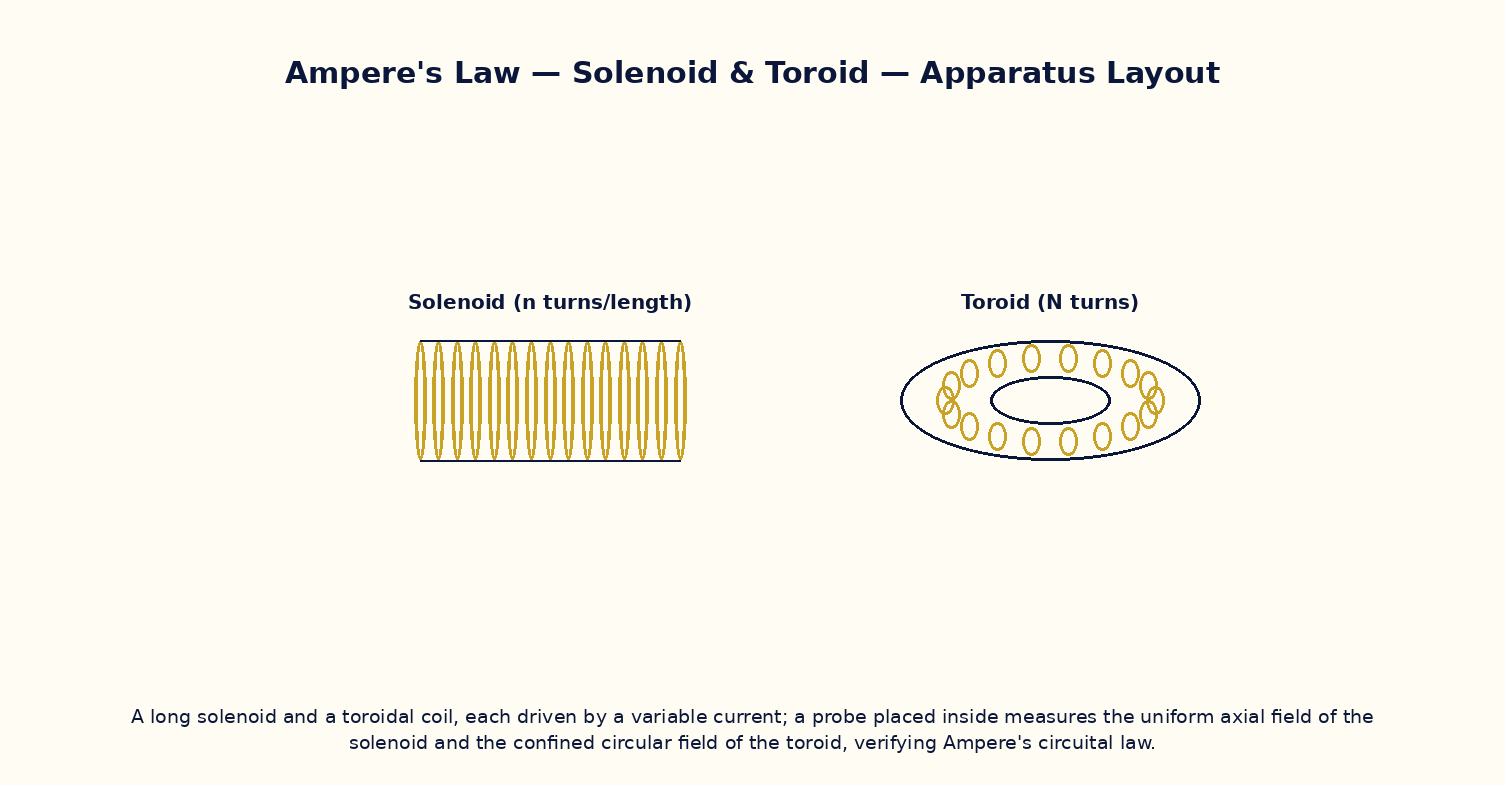
Aim
To verify Ampere's circuital law by computing the magnetic field inside a long solenoid and a toroid, and to study the field's uniformity and its dependence on turns density and current.
Theoretical Background
Ampere's circuital law states ∮ B·dl = μ₀ I_enc around any closed Amperian loop, where I_enc is the current enclosed. For a long, tightly-wound solenoid with n turns per unit length, a rectangular Amperian loop (one side inside, one outside, both parallel to the axis) gives a uniform interior field B = μ₀nI, with negligible field outside the winding — an excellent approximation for a solenoid whose length far exceeds its radius. A toroid (a solenoid bent into a closed ring) confines the field entirely within the torus's core with zero field elsewhere; applying Ampere's law to a circular loop of radius r within the core gives B(r) = μ₀NI/2πr, which is not perfectly uniform across the core's cross-section (it is stronger on the inner side) unless the core radius is much larger than the tube radius.
Governing Formula
| Symbol | Meaning |
|---|---|
| B | magnetic field (T) |
| n | turns per unit length of the solenoid (turns/m) |
| N | total turns of the toroid |
| I | current (A) |
| r | radial distance from the toroid's axis, within the core (m) |
Interactive Controls
Launch the simulator and use the following controls on the Ampere's Circuital Law — Field Inside a Solenoid & a Toroid panel:
| Control | Symbol | Range | Default |
|---|---|---|---|
| Solenoid turns density | n | 5–100 turns/cm | 30 turns/cm |
| Current | I | 0.1–5 A | 1 A |
| Probe position (0=centre, 1=at the end, 2=outside) | x | 0–2 | 0 |
| Toroid major radius | R | 5–30 cm | 15 cm |
| Toroid total turns | N_t | 50–1000 | 300 |
Procedure
- For the solenoid, place the probe well inside (away from the ends) and vary n and I independently, verifying B = μ₀nI in each case.
- Move the probe toward one end of the solenoid and note the field dropping to roughly half its central value at the very end (edge effect), then to nearly zero just outside.
- For the toroid, place the probe inside the core and vary the radial position r; verify B ∝ 1/r within the core cross-section.
- Confirm the toroid's field is exactly zero for a probe placed outside the core (either inside the central hole or outside the outer radius).
- Compare the interior solenoid field at the same nI product with different individual choices of n and I to check only the product matters.
- Sketch a suitable rectangular Amperian loop for the solenoid and a circular one for the toroid, and verify ∮B·dl = μ₀I_enc numerically in both cases.
Observation Table
| S. No. | Configuration | n or N | Current I (A) | Probe position | Field B (×10⁻³ T) | |---|---|---|---|---|---|| | | | | | | | | | | | | | | | | | | | | | | | | | | | | | | | | | | |
Graph
Solenoid Field Along the Axis (end effects) — flat top, drops to ~0.5 at each end, ~0 outside
Calculations
Use the governing formula above with your tabulated observations to compute the required result for each row. Show at least one complete sample calculation with units.
Result
| Configuration | Field uniformity | Verified law | Remarks | |---|---|---|---|| | | | | |
Precautions
- Ensure the solenoid is 'long' (length ≫ radius) before applying the idealized formula B = μ₀nI; note deviations for short coils.
- For the toroid, keep the probe strictly within the core cross-section; readings just outside the winding should read zero.
- Keep turns tightly and uniformly wound in the model — gaps between turns would break the assumed symmetry.
- Distinguish n (turns per unit length, used for the solenoid) from N (total turns, used for the toroid formula) carefully.
Maximum Permissible Error
B = μ₀nI is a simple product, so fractional errors in n and I add directly.
Viva-Voce Questions
- State Ampere's circuital law and explain the choice of Amperian loop used to derive the solenoid's field.
- Why is the field of an ideal solenoid exactly zero outside the winding, but not exactly zero for a real, finite solenoid?
- Derive the toroid's field formula using a circular Amperian loop.
- Why is a toroid's field not perfectly uniform across its cross-section, unlike an idealized long solenoid?
- Under what conditions does Ampere's law alone suffice to determine B, without needing the full Biot–Savart integral?
- How is Ampere's law modified for time-varying fields (Maxwell's displacement-current correction)?