Coulomb's Law & Force Between Point Charges
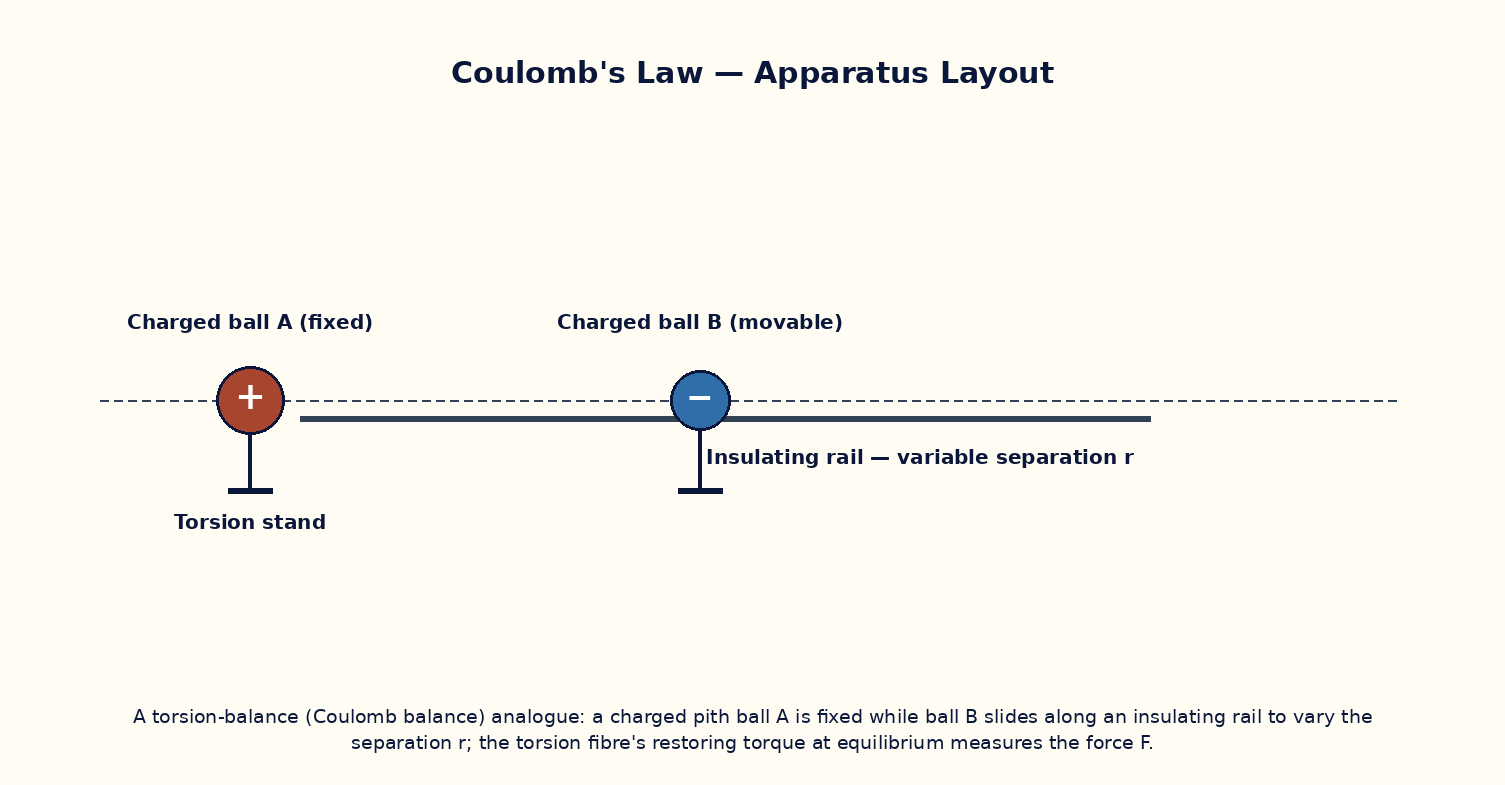
Aim
To verify the inverse-square dependence of the electrostatic force between two point charges on their separation, and its direct proportionality to the product of the charges, using a torsion-balance style virtual setup.
Theoretical Background
Coulomb's law states that the force between two point charges q1 and q2 separated by a distance r in a medium of permittivity ε acts along the line joining them, is directly proportional to the product of the charges and inversely proportional to the square of the distance between them: F = (1/4πε₀)·q1q2/r² in free space (or F = (1/4πε₀εr)·q1q2/r² in a dielectric medium of relative permittivity εr). The force is repulsive for like charges and attractive for unlike charges. This law is the electrostatic foundation from which Gauss's law, the electric field, and the potential of a point charge are all derived, and it underlies the entire multipole expansion used later for dipoles and extended charge distributions.
Governing Formula
| Symbol | Meaning |
|---|---|
| F | electrostatic force between the charges (N) |
| q₁, q₂ | the two point charges (C) |
| r | separation between the charges (m) |
| ε₀ | permittivity of free space (8.854×10⁻¹² F/m) |
| εr | relative permittivity of the surrounding medium |
Interactive Controls
Launch the simulator and use the following controls on the Coulomb's Law & Force Between Point Charges panel:
| Control | Symbol | Range | Default |
|---|---|---|---|
| Charge 1 | q₁ | 1–50 nC | 10 nC |
| Charge 2 | q₂ | 1–50 nC | 10 nC |
| Separation | r | 2–30 cm | 10 cm |
| Medium relative permittivity | εr | 1–80 | 1 |
Procedure
- Set the medium to vacuum/air (εr = 1) and fix q₁ = q₂ = 10 nC.
- Vary the separation r from 2 cm to 30 cm in steps of 2 cm, noting the computed force F at each step.
- Plot log F versus log r and determine the slope; it should equal −2, confirming the inverse-square law.
- Fix r = 10 cm and vary q₂ from 5 nC to 50 nC, keeping q₁ fixed, and verify F ∝ q₂ (a straight line through the origin on an F vs q₂ plot).
- Change the medium permittivity εr (e.g. to 80 for water) and observe the reduction in force at fixed q and r.
- Reverse the sign of one charge and note that the force arrow reverses from repulsive to attractive.
Observation Table
| S. No. | Separation r (cm) | q₁ (nC) | q₂ (nC) | Force F (×10⁻⁶ N) | log r | log F | |---|---|---|---|---|---|---|| | | | | | | | | | | | | | | | | | | | | | | | | | | | | | | | | | | | | | | | |
Graph
log F vs log r (slope method) — slope ≈ -2
Calculations
Use the governing formula above with your tabulated observations to compute the required result for each row. Show at least one complete sample calculation with units.
Result
| Quantity | Slope of log F vs log r | Expected value | % deviation | |---|---|---|---|| | | | | |
Precautions
- Keep the charges' magnitudes fixed while varying only one parameter at a time.
- Ensure the separation r is always much larger than the physical size of the charged spheres so the point-charge approximation holds.
- Note the sign convention: like charges repel (positive F, arrow pointing outward) and unlike charges attract.
- Discharge and re-zero the torsion fibre between widely different charge settings to avoid residual twist error.
Maximum Permissible Error
F ∝ q₁q₂/r² is a product/quotient of measured quantities, with r entering squared, so its fractional error carries a factor of 2.
Viva-Voce Questions
- State Coulomb's law in vector form and explain each term.
- Why does the electrostatic force obey an inverse-square law rather than, say, an inverse-cube law?
- How does the force change if the experiment is repeated in a dielectric medium instead of vacuum?
- Derive the electric field of a point charge starting from Coulomb's law.
- Compare the magnitude of the electrostatic and gravitational forces between two electrons.
- What is the principle of superposition, and how does it apply to a system of more than two charges?