Crossed E & B Fields — Velocity Selector & Cyclotron Motion
Aim
To determine the velocity selected (undeflected) by a region of crossed uniform electric and magnetic fields, and to compute the cyclotron radius of the selected charged particle once it enters a pure magnetic field region.
Theoretical Background
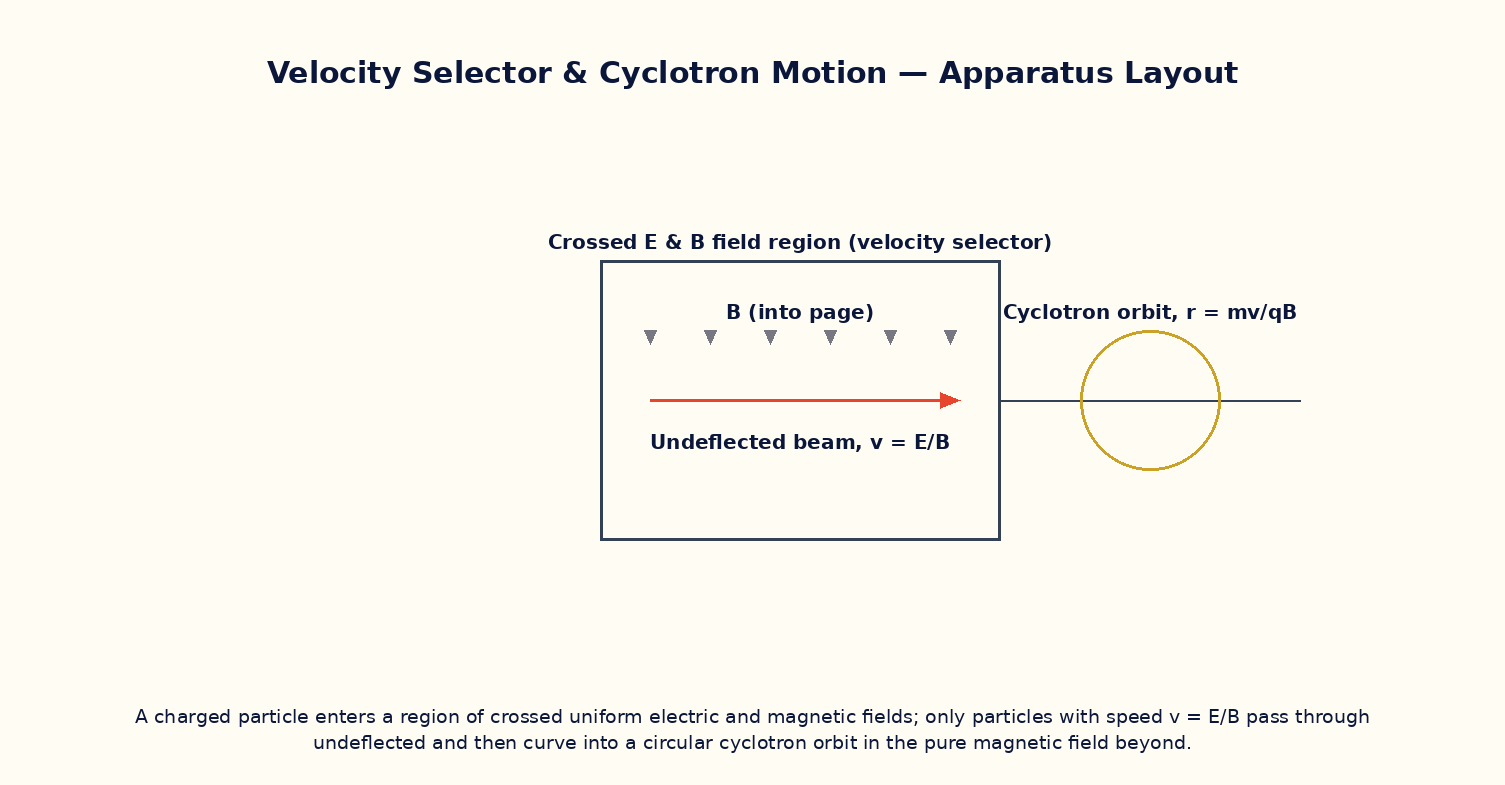
In a velocity selector, a charged particle moving through a region containing perpendicular uniform electric and magnetic fields experiences an electric force qE and a magnetic force qv×B. For a particle moving perpendicular to both fields, these forces are exactly balanced (and the particle travels in a straight line undeflected) only when qE = qvB, i.e. when its speed equals v = E/B, independent of the particle's charge or mass. This makes the velocity selector a clean way to prepare a beam of particles with a single, precisely known speed, which is the first stage of instruments such as the mass spectrometer. Once the selected beam leaves the crossed-field region and enters a region containing only the magnetic field, the magnetic force alone provides the centripetal force for circular (cyclotron) motion, with radius r_c = mv/(qB) — a radius that now does depend on the particle's mass-to-charge ratio, which is exactly how a mass spectrometer distinguishes between different ions.
Governing Formula
| Symbol | Meaning |
|---|---|
| v | selected (undeflected) particle speed (m/s) |
| E | electric field in the selector region (V/m) |
| B | magnetic flux density (T) |
| r_c | cyclotron radius in the pure magnetic-field region (m) |
| m/q | mass-to-charge ratio of the particle |
Interactive Controls
Launch the simulator and use the following controls on the Crossed E & B Fields — Velocity Selector & Cyclotron Motion panel:
| Control | Symbol | Range | Default |
|---|---|---|---|
| Electric field | E | 1–50 kV/m | 10 kV/m |
| Magnetic flux density | B | 1–100 mT | 20 mT |
| Mass-to-charge ratio (×10⁻⁸ kg/C) | m/q | 0.5–20 | 5.7 |
Procedure
- Set E = 10 kV/m and vary B from 1 mT to 100 mT, recording the selected velocity v = E/B at each setting.
- Plot v versus 1/B and verify a straight line through the origin, confirming v ∝ 1/B at fixed E.
- Fix B and vary E, verifying v ∝ E.
- For a fixed selected velocity, compute and tabulate the cyclotron radius r_c for several values of m/q, and verify r_c ∝ (m/q).
- Discuss how this arrangement could be used to separate ions of two different isotopes with the same charge but slightly different mass.
Observation Table
| S. No. | E (kV/m) | B (mT) | v = E/B (km/s) | m/q (×10⁻⁸ kg/C) | r_c (m) | |---|---|---|---|---|---|| | | | | | | | | | | | | | | | | | | | | | | | | | | | | | | | | | | |
Graph
Selected velocity v vs 1/B
Calculations
Use the governing formula above with your tabulated observations to compute the required result for each row. Show at least one complete sample calculation with units.
Result
| Quantity | Slope of v vs 1/B | Expected value | % deviation | |---|---|---|---|| | | | | |
Precautions
- Ensure E and B are strictly perpendicular to each other and both perpendicular to the initial particle velocity.
- Only particles at exactly v = E/B pass through undeflected; note that this condition is independent of the particle's charge sign as long as forces are computed with correct signs.
- Change only one field at a time when verifying the individual E and B dependences.
- Keep the particle's speed non-relativistic (v ≪ c) so the classical formulas remain valid.
Maximum Permissible Error
v = E/B is a simple quotient of two measured quantities, so their fractional errors add directly.
Viva-Voce Questions
- Derive the velocity-selection condition v = E/B from the balance of electric and magnetic forces.
- Why is the selected velocity independent of the particle's mass and charge?
- Derive the cyclotron radius formula r_c = mv/(qB) from Newton's second law for circular motion.
- How is a velocity selector used as the first stage of a mass spectrometer?
- What happens to the trajectory if the particle's speed does not exactly equal E/B?